"Senna multiglandulosa"
A Promising Feedstock for Biochar Production and Carbon Sequestration
As the world seeks innovative solutions to address climate change, soil degradation, and sustainable biomass utilisation, biochar has emerged as a promising technology. While agricultural residues and forestry by-products are commonly used as biochar feedstocks, there is growing interest in dedicated biomass crops that can provide a reliable feedstock supply while delivering additional environmental benefits.
At Siena, we have been investigating the potential of Senna multiglandulosa as a sustainable feedstock for biochar production. Our preliminary findings are promising, and we are actively seeking collaborators to further evaluate its agronomic, environmental, and commercial potential.
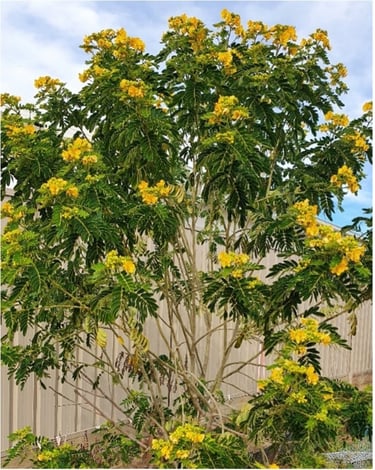
Mature Senna multiglandulosa cultivated in Wagga Wagga, NSW, demonstrating its potential as a sustainable biomass feedstock for biochar production and carbon sequestration.
What is Senna multiglandulosa?
Senna multiglandulosa, commonly known as glandular senna, downy senna, or buttercup bush, is a hardy perennial shrub native to Mexico, Guatemala, and western South America. The species has become naturalised in parts of Australia, including regions of New South Wales.
Under the climatic conditions of the Wagga Wagga region, the species has demonstrated moderately rapid growth, reaching approximately 1.5–2.0 metres in height within two years and developing a canopy diameter of up to 2 metres. Flowering typically occurs from late summer to autumn. Preliminary observations also suggest moderate drought tolerance and an ability to withstand frost conditions.
These characteristics indicate potential suitability for biomass production in environments where conventional crops may face limitations.
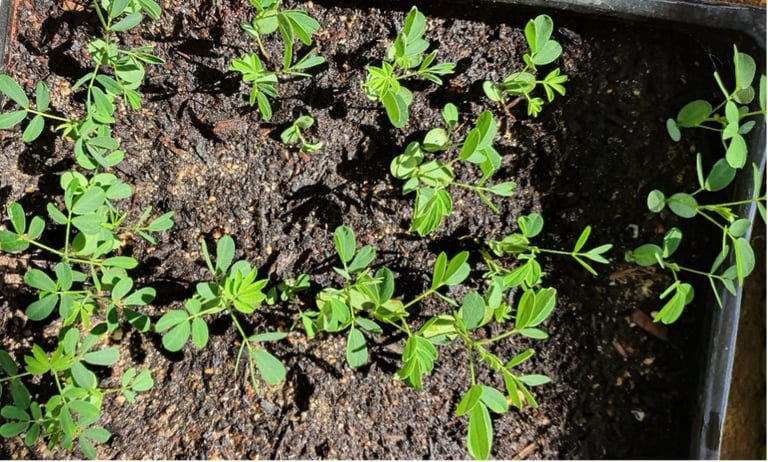
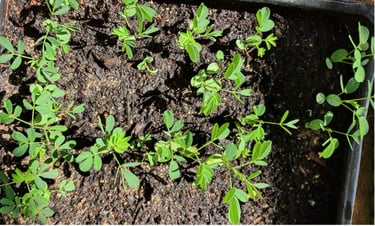
Two-month-old Senna multiglandulosa seedlings cultivated under field conditions in Wagga Wagga, NSW
Why Explore Senna multiglandulosa for Biochar?
Easy to multiply using seeds
Senna multiglandulosa can be readily propagated from seed, making it a practical species for large-scale establishment. Acid treated seeds typically germinate within 7–10 days, producing vigorous seedlings. Observations from our trials indicate that seedlings can reach heights of approximately 10–15 cm within three months of germination. This rapid establishment and early growth suggest that the species may be well suited to biomass production systems requiring cost-effective and scalable propagation methods.
High Biomass Production Potential
Initial observations suggest that S. multiglandulosa can produce substantial above-ground biomass under relatively low-input conditions. Further field trials are currently underway to quantify biomass yields across different environments and management systems.
Potential Adaptation to Marginal Lands
Preliminary observations suggest that the species may be capable of establishing on relatively low-fertility or degraded soils. If confirmed through further research, this could provide opportunities to utilise underused land for biomass production and carbon sequestration without competing directly with food production.
Nitrogen Fixation Potential
As a member of the legume family, S. multiglandulosa may contribute to soil fertility through biological nitrogen fixation. Further investigation is needed to quantify this contribution and its implications for sustainable biomass production systems.
Carbon Sequestration Opportunities
When converted into biochar through pyrolysis, a significant proportion of plant carbon can be stabilised in a form that may persist in soils for hundreds to thousands of years. This creates opportunities for long-term carbon storage and potential participation in emerging carbon and biodiversity markets.
Preliminary Biochar Characterisation
Biochar produced from S. multiglandulosa biomass has shown promising characteristics, including:
Approximately 72% stable carbon content
Presence of plant nutrients including nitrogen (1.11%), potassium (1.01%), calcium (0.92%), magnesium (0.22), and phosphorous (0.16%).
The low bulk density (0.29 kg/L) indicates that the biochar can improve soil porosity, aeration, and water-holding capacity
Presence of elements such as zinc, manganese, iron, copper, boron, and silicon may provide additional agronomic benefits.
These preliminary results suggest potential applications in agriculture, soil improvement, and environmental management. However, additional testing and validation are required across a wider range of production conditions and end uses.
Environmental Remediation Potential
Beyond agricultural applications, biochar is increasingly being investigated as a material for environmental remediation. Ongoing research worldwide is examining its capacity to adsorb contaminants such as heavy metals, excess nutrients, and emerging pollutants including PFAS compounds.
We are interested in exploring whether biochar derived from S. multiglandulosa possesses characteristics suitable for environmental remediation applications. Future research will investigate opportunities to modify Senna biochar to improve its capacity for contaminant removal, with potential applications in stormwater filtration, water treatment, and broader environmental management systems.
Potential Environmental Co-Benefits
The cultivation of S. multiglandulosa may provide benefits beyond biomass production, including:
Habitat resources for pollinators
Soil erosion control
Rehabilitation of degraded land
Increased landscape resilience
Contributions to integrated carbon and biodiversity projects
These potential co-benefits require further assessment through field-based research.